This initiative was to strengthen the National Malaria Control of Equatorial Guinea, supported by the public private partnership between the Marathon Oil Company, the Government of Equatorial Guinea, and implemented by Medical Care Development International.
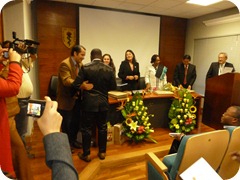
After six months of training in malaria control, students from Equatorial Guinea have successfully completed the "International Diploma in Malaria Control", held at the Universidad Peruana Cayetano Heredia (UPCH) between the months of February to June 2011; Tuesday June 6th was their graduation day.
 In the closing ceremony attended by Dr. Fabiola Leon-Velarde, Dean of the UPCH and Foundation President Cayetano Heredia; Dr. Patricia Garcia, Dean of the Faculty of Public Health at the university; Dr. Alejandro Llanos, Training Program Coordinator; Dr. Gloria Nseng, Director of the National Malaria Control of Equatorial Guinea; Jenny Henderson, National Coordinator of the Strategy for Malaria Control of the Peruvian Ministry of Health; Dr. Pablo Aguilar, the representative of Medical Care Development International (MCDI); Guillermo Gonzales, the representative of PAHO / WHO and NAMRUD; and Dr. Jaime Chang, the representative of USAID.
The International Diploma is part of the activities of the Malaria Control Project on the island of Bioko, within the capacity building component, which began in 2003 as part of the response of the Equato-Guinean Ministry of Health and Welfare to the high morbidity and mortality caused by malaria. This project is funded by the Government of Equatorial Guinea, Marathon Oil Company and its partners, comprised of a corporate social volunteer initiative and public private partnership, which is implemented with the technical support of the North American NGO Medical Care Development International (MCDI), which also implement projects in over 20 countries in Africa, 17 of them funded by PMI-USAID under the IMaD project, an initiative to strengthen malaria diagnostics. In addition, IMaD is a principal recipient of the Global Fund and other funding institutions.
 After obtaining good results with 35% reduction of malaria morbidity in children under 5 years old between 2003 and 2008 and becoming the first country in sub-Saharan Africa in achieving the Millennium Development Goals, as a part of institutional strengthening, the Malaria Control Program developed a process of selection, recruitment and training of eight professionals in a transparent manner starting from the creation of the National Human Resources Committee, which held a session of a total of 129 candidates in 2010. Upon returning to Equatorial Guinea, the eight students joined the National Malaria Control Program and Malaria Control Project on the island of Bioko to assist in strengthening the operations of a program of high strategic importance due to the fact that malaria remains the leading cause of death to the poorest populations in the country. The students will participate in the next phase of training, part of the Transition Plan, in which MCDI Technical Officers will continue with on-site training of the project and program operations, a process that will include a robust monitoring and supervision to ensure the completion of all the indicators. It is anticipated that once students reach the desired level, MCDI expatriate staff will leave the project and the national staff will assume their roles.
This training began in September 2010 at the National Public Health Institute of Mexico where the students received lessons on basic malaria concepts. The following stage was held in the U.S. at the School for International Training in Vermont, where students were trained in monitoring and evaluation of malaria and took English as a second language courses. In addition, they had the opportunity to meet representatives of Congress to discuss global health issues.
The third stage took place in the city of Lima, led by the Foundation Cayetano Heredia. The personalized training sessions provided the students with the opportunity to thoroughly analyze key thematic topics. After training in Lima, the students participated in a practical training in the city of Iquitos in the Loreto region. The students were able to observe first-hand the inner workings of the management, implementation, monitoring and evaluation of a malaria control strategy at the regional, district and local levels. 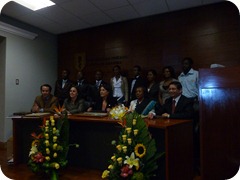 As part of the final requirement to complete the academic program, students conducted a situation analysis of institutional and strategic planning of the malaria control strategy in Iquitos. The students identified key problems within the areas of human resources, case management and community participation that needed to be improved. The students formulated an intervention proposal, based on the situational analysis, for the Regional Bureau of Health in Iquitos, which was presented at graduation ceremony to a panel attended by the Director of DIRESA Loreto, Dr. Hugo Rodriguez.
This is a successful effort of institutional strengthening of triangular cooperation of South-North-South, in the framework of the Global Health Initiative, supported by a public-private partnership, where experiences and knowledge were exchanged between Africa and America.



 The Alliance for Malaria Prevention is a partnership comprised of over 40 partners, including government agencies, private sector businesses, public sector organizations, faith-based organizations, and humanitarian organizations. Each of these partners provides an invaluable contribution to the partnership in supporting countries reach the RBM 2010 targets through increased LLIN ownership and use. The alliance has recently released its second edition of toolkit for developing integrated campaigns to encourage the distribution and use of long lasting insecticide-treated nets and be downloaded from

